
Same words, wrong tone. Collectors say "have a nice day." Leaders hear the hangover.
Collectors can finish with the compliant closing line and still leak outcome frustration into how it sounds. The defense is simple: "I said have a nice day." Compliance and QA leaders on an AccountsRecovery panel said agents often cannot hear that closing hangover live, and that transcripts miss tone and how the conversation actually flowed. Dials and checkbox QA catch the words. They miss personal audible drift on the close after a bad call.
This is for collections compliance, QA, and ops leaders (VP Compliance, VP Network Compliance, COO / QA listening leads) on ARM floors. The object is the same closing phrase with the wrong tone, plus the "I said the words" defense, plus the live gap where collectors cannot hear themselves in the moment.
Download Ontor - 14 days free, no card required
Weimer: the nice-day close that changes with the outcome
David Weimer (Vice President and Chief Compliance Officer, Kramer & Frank, P.C.) put the closing hangover in plain practice language on the Other Half of QA panel:
"We at one time had a collector who, finished every call with you, have a nice day. And if the call hadn't gone the way she wanted it to the tone of the you have a nice day was a lot different than the calls that went well. Her defense was well."
"I said, have a nice day. Yeah tone matters and it matters in the text too."
The script line was delivered. The consumer still heard a different close after a bad outcome than after a good one. Scorecards that only check that the closing phrase was spoken will green-light that contact. The hangover sits in the voice, not in the checkbox.
Weimer also ties tone to listening earlier in the call. When the collector is not listening, the consumer's tone changes: talking faster, louder, maybe over the top of the collector. Closing-line drift is not the only place tone matters. It is the place where the defense is strongest, because the words were right.
Brown: you cannot hear yourself in the moment
Tonia Brown (Vice President of Network Compliance, EverChain) argues that collectors should be active participants in QAing their own calls, because classroom training does not give them the same cue awareness once they hear themselves back:
"I think allowing the collector to be an active participant in QAing their own calls really helps them in a way that classroom training really doesn't, once they hear it and they can under."
"A lot of times hindsight's 2020, right? You listen to yourself and you're like, wow, I really do sound like I need to be barefoot and pregnant in the woods. I don't know. I have an accent."
The punchline for ops is the live gap, not the accent joke:
"you don't have that ability to do that for yourself in the moment."
Self-QA on a recording is hindsight. It helps the next coaching cycle. It does not give the collector a private cue while the closing hangover is still forming after a rough outcome.
Brown also shut down a sarcastic closing pattern on her floors:
"I used to have a collector that said, I hope you have the day you deserve. I was like please stop doing that."
Same family as Weimer's nice-day hangover: a closing that can pass as "polite" on paper and still land as tone the consumer hears.
Bohling: transcripts miss tone; checkboxes crowd out conversation
LaDonna Bohling (collections operations / QA listening leader, Contract Callers; she listens to thousands of QA calls) separates what was said from how it sounded:
"They show what was said, but you sometimes it's hard to pick up the tone. I think that transcripts sometimes miss the tone and how that the conversation actually flowed."
She also watched call analytics throw false "upset" flags on southern dialect that disappeared when she listened back. Transcripts and text analytics can put you on a path if a pattern shows up. They are not ground truth for closing-line tone.
Separately, she names the culture that makes the words-only defense easy: training priority drifted to check boxes, read disclosures, follow the script, stay compliant, versus the actual conversation:
"Because again, we know we're just coming to the place where we're just, telling people to check the boxes, read the disclosures, follow the script, make sure you stay compliant."
"Those seem to be the priority versus, the actual conversation."
She still teaches pause, mirroring, and tactical empathy after "Payment in full is due. How did you wanna take care of this?" Checkbox compliance can still leave the close sounding like the outcome, not like the person.
What this article is not answering
Published Ontor collections pieces already cover nearby voice moments. Overlap on "voice versus your own usual range, and QA or dials miss it" is real, on the order of half the framing. The spine here is different.
- QA tone versus baseline answers Empathy and Tone scores that miss a strong collector drifting off their own baseline (including AI that misses tone). This piece starts from the compliant closing phrase and the "I said have a nice day" defense after a bad outcome.
- Recoveries look fine; complaints say how they said it answers Conklin complaint-despite-recovery, triggering hardship, and Eppert validation-window hang-ups. Not the closing hangover.
- Compliance hangover self-reset answers not sounding like yourself after a rough Mini-Miranda / compliance open (Reynaud-adjacent compliance open residue). Not the polite close after a bad negotiation.
- First 10 seconds of tone answers opener tone that decides whether someone stays on the phone. This is the exit line, not the greeting.
- Demeanor drift answers live floor monitoring that still misses a mid-shift demeanor shift. Not this.
- Post-RPC ask freeze answers the freeze after Mini-Miranda and right-party contact. Not the close.
- Remote, no hallway reset answers lost hallway and breakroom peer resets. Not this.
- Energy match versus flat under hostility answers taught energy-match that still leaks upset. Not the nice-day defense.
- Cool-down between hostile calls answers readiness after a hostile disposition.
- Break-window fatigue answers distraction around breaks.
Same beachhead. Different object: compliant closing words, outcome-contingent tone leak, "I said the words" defense, and agents who cannot hear themselves in the moment on that close.
Vendor color only: burnout as tone deviations
One vendor piece describes a mechanism. It is not the buyer spine, and it is not an ARM scorecard.
TEC Services Group (collections infrastructure vendor) writes that when burnout takes hold it shows up as subtle disengagement, declining empathy, slower call pacing, compliance slips, and increased absenteeism, and that burnout reduces focus and emotional regulation, which increases disclosure errors, tone deviations, and procedural mistakes (Operational Strategies for Reducing Debt Collection Agent Burnout). Useful as market language that "tone deviations" show up when regulation slips. Cap it there. Do not treat it as buyer evidence for your floor's closing QA.
What dials and checkbox QA still miss
The stack these leaders already run:
- Closing lines and disclosures scored as said / not said
- Self-QA listen-backs after the fact (Brown's hindsight path)
- Transcripts and call analytics that show words, and sometimes false emotion flags (Bohling)
- Checkbox / script priority that can crowd out conversation skill (Bohling)
- Live monitoring and coaching that still depend on a human ear catching the hangover
Useful. Incomplete for the audible leave on the close. A script audit catches "have a nice day." A transcript can print the same words on a good close and a frustrated close. Self-QA helps tomorrow. It does not show whether confidence, stress, energy, clarity, strain, or breathing left that person's own usual range in the short speech windows of the closing line after a rough outcome.
Consumers hear the hangover first. Leaders meet it later as a complaint, a coaching listen, or a defense that cites the words.
What Ontor adds on the close (private first)
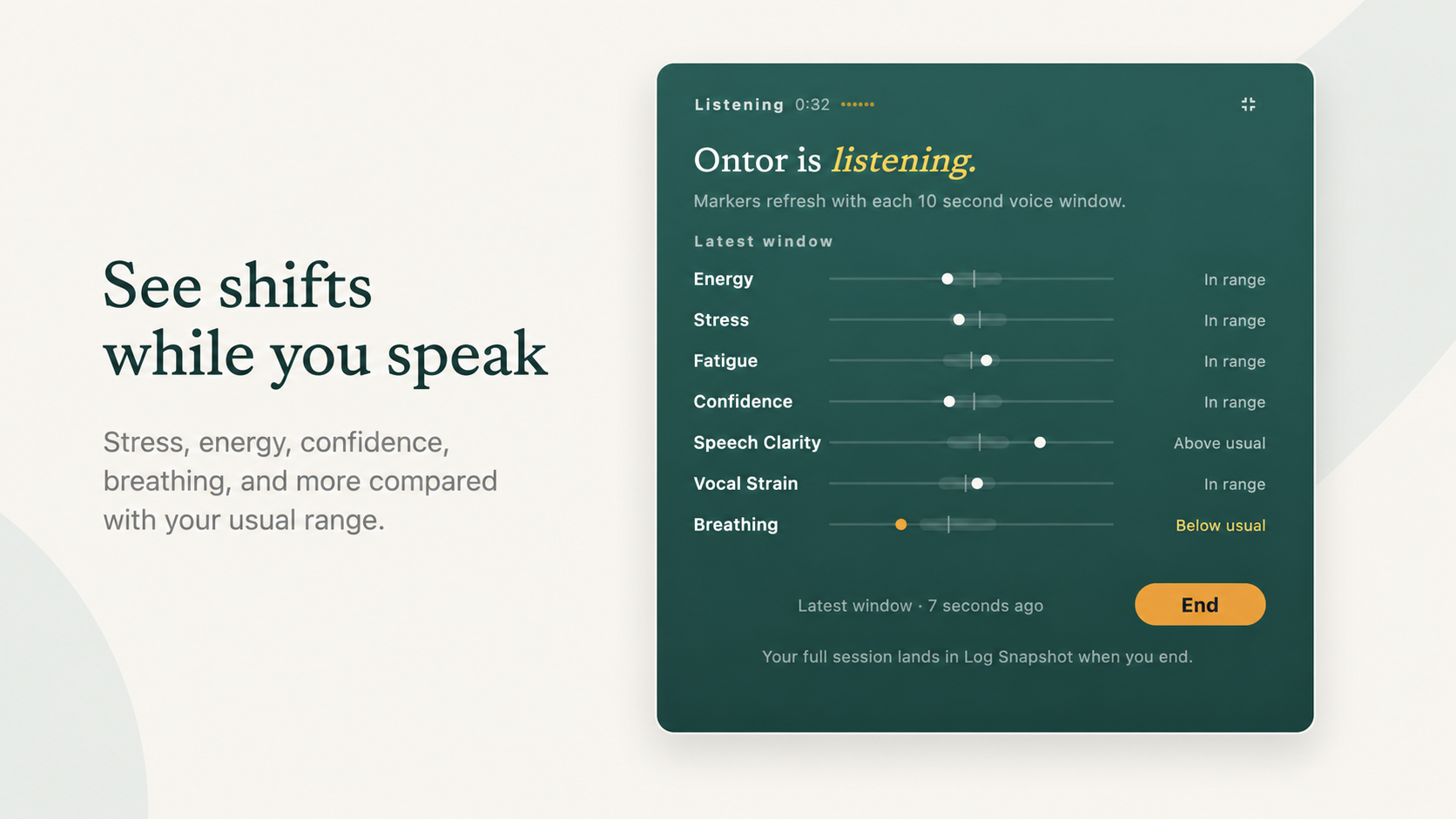
Ontor reads how you sound, not what you said. While someone speaks, it compares voice signals with that person's own usual range. It does not react to every unusual second. It looks for a lasting shift. Signals on the public product page are energy, stress, fatigue, confidence, speech clarity, vocal strain, and breathing. Each one is how the voice sounds versus your own usual range, not a population grade. When a lasting shift shows up, Ontor can suggest a short reset. You can compare before and after.
The live listening view refreshes markers with each 10 second voice window. That is the product's own label, not a clinical sampling claim.
Boundaries, said plainly:
- Ontor does not replace closing scripts, disclosures, self-QA listen-backs, or Bohling's conversation coaching.
- Ontor does not diagnose sarcasm, burnout, or a health condition, and a marker move is not a clinical outcome.
- Ontor does not claim that a marker change proves fewer complaints, higher recoveries, or better retention.
- For teams, leaders see aggregate patterns that can inform workload, coaching, and support. Individual sessions and readings stay with the person. That is not a hire or fire score. Soft secondary path only: Ontor for teams.
In my own Ontor session history (founder exploratory data from my own product use, not your floor's outcome data), the closing-line tone leak shows up the same way Brown describes the in-moment gap. After a rough outcome I still know the compliant close. Stress, confidence, or energy can sit outside my usual band in the short windows while I say the polite line. That is the "I said have a nice day" defense as personal-baseline leave, not as a missed script word. I cannot hear that hangover the way a coach hears it on playback. A private usual-range cue during or right after that close, before the next one, is the tool step. It is not a claim that one cycle fixes closing complaints.
Here is live listening from my own Ontor session. Markers refresh with each 10 second voice window and sit against my usual range. Read it as a private check on the close after a rough outcome, not as a QA score:
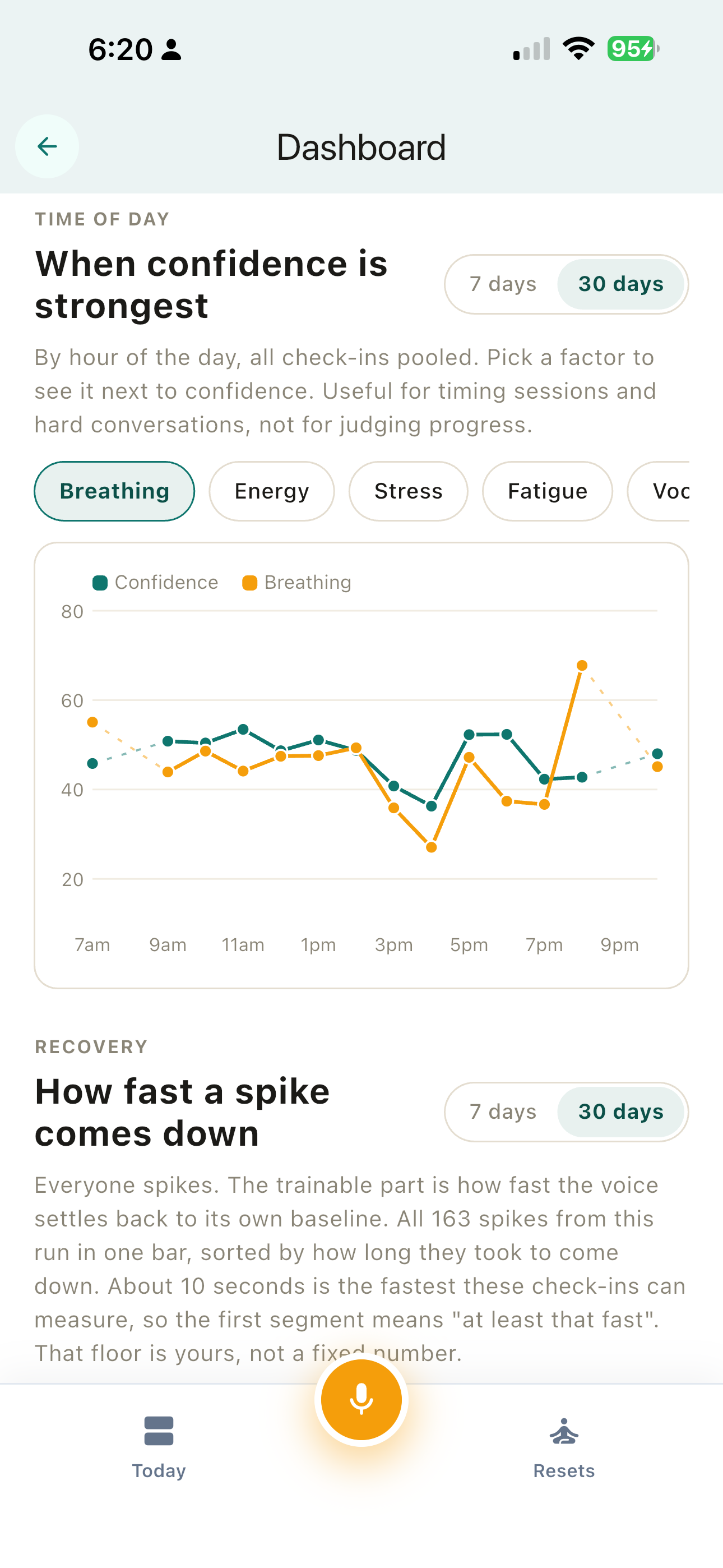
Here is confidence beside breathing by hour from that same session history. The screen is for timing hard conversations, and it says it is not for judging progress. Read the shape as founder exploratory data on how confidence and breathing move across a speaking day, including windows where a polite close can still leave the band:
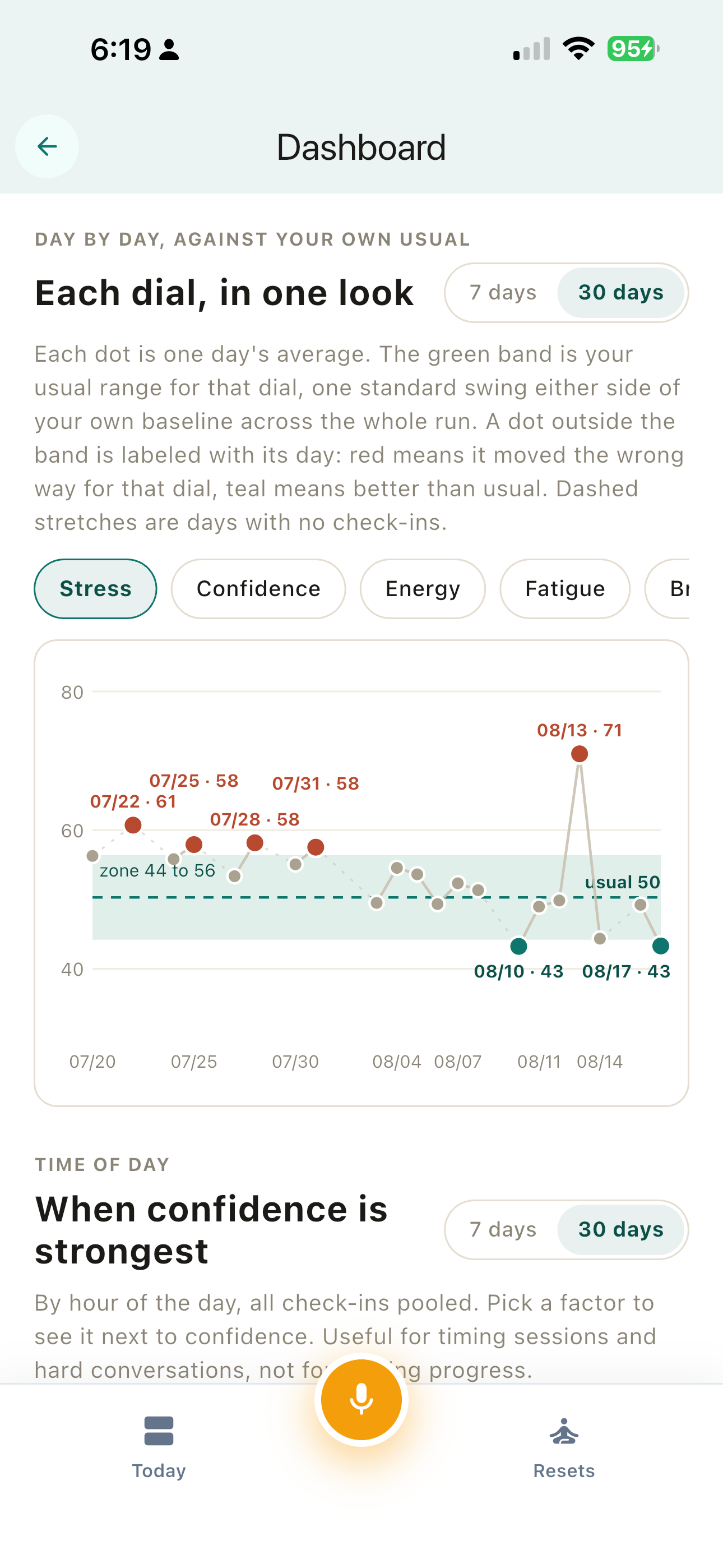
Here is stress day by day against my own usual band. The screen labels a zone of 44 to 56 around a usual of 50, and it marks days that sit outside that band. Useful as a private view of how often voice-state leaves the band across calls. It is not a collector ranking, and it is not proof that a reset caused a calmer nice-day close:
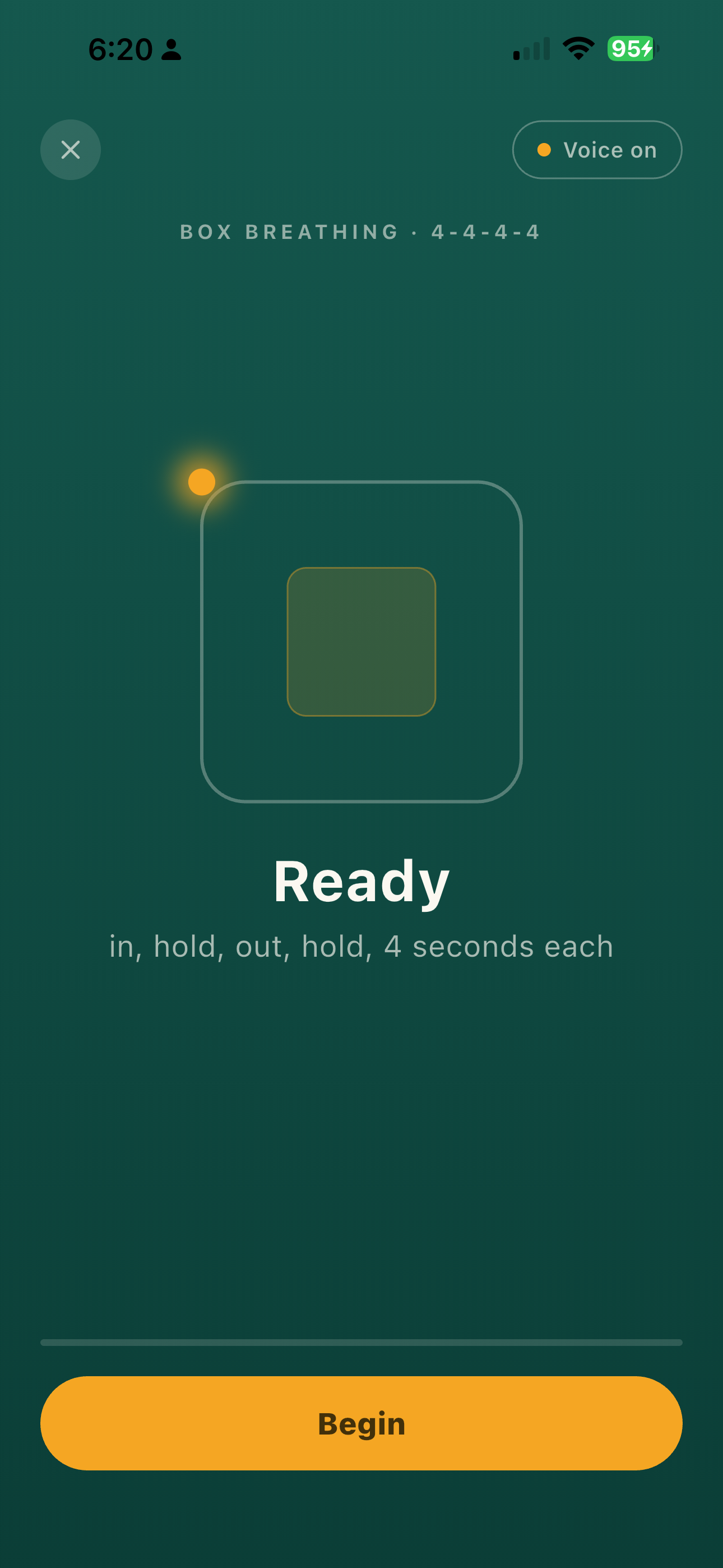
And the short reset the product offers when a lasting shift shows up: box breathing, 4-4-4-4. That is a private pause you can take after a lasting shift on a rough close, before the next dial. It is not a medical protocol, and it is not a substitute for Brown's self-QA or Weimer's tone coaching:
The claim stays narrow. When the closing words were right and the hangover was in the tone, a private usual-range cue plus an optional short reset is a loop the collector can run before the next close. Leaders, if they look at all, look at cohort patterns only.
Download Ontor - 14 days free, no card required
What to try on the next close after a rough outcome
Do not wait for another coaching cycle if you already know the words and the tone are splitting on the exit line.
- Install Ontor on the machine you already use for collections calls.
- On the next close after a call that did not go the way you wanted, notice whether stress, confidence, energy, clarity, strain, or breathing sit outside your own usual range in the short speech windows while you say the compliant closing line. Listen for how the close sounds against your personal baseline. Not against a floor average, and not against whether the transcript printed "have a nice day."
- If a lasting shift shows up, take the short suggested reset before you place the next dial and deliver the next close. Do not treat "I said the words" as proof the hangover was gone.
- If you lead compliance or QA, keep personal readings with the person. Use aggregate patterns only if you later want a cohort view of strain on closing blocks. Do not turn Ontor into a closing QA score or a hire-fire tool.
If you run a floor and want a measured team look later, the light secondary path is Ontor for teams. The primary step is still install, on the next call.
Do not promise fewer complaints or higher recoveries. Measure whether you can tell when the close left your usual range after a rough outcome.
Bottom line
Collectors can say "have a nice day" and still leak the outcome into tone. David Weimer heard the same closing phrase land differently after a bad call than after a good one, and the defense was that she said the words. Tonia Brown names why self-QA is mostly hindsight: you do not have the ability to hear yourself that way in the moment. LaDonna Bohling adds that transcripts miss tone and flow, and that checkbox compliance can crowd out the actual conversation. Ontor does not replace that coaching. It shows audible confidence, stress, energy, and breathing against your own usual range in short voice windows on the close, and it can offer a short reset before the next one.
Try it on the next close after a rough outcome. Notice how the exit line sounds versus your personal baseline. Take the short reset if a lasting shift shows up.
Download Ontor - 14 days free, no card required
About the author
Sabber Ahamed is the founder of Ontor and an applied ML scientist (PhD, geophysics and signal processing) who builds on-device voice tools. Ontor compares how you sound with your own usual ranges and can suggest a short reset. Marker changes are not clinical outcomes and they are not revenue proof.
References
- David Weimer, Tonia Brown, LaDonna Bohling, Ryder Thompson, Dennis Barton, Mike Gibb. "The Other Half of QA: Coaching Teams on What They Didn't Say on the Call or Text" webinar transcript. AccountsRecovery.net, March 2026. https://www.accountsrecovery.net/wp-content/uploads/2026/03/The-Other-Half-of-QA_-Coaching-Teams-on-What-They-Didnt-Say-on-the-Call-or-Text_Transcript.pdf
- TEC Services Group. "Operational Strategies for Reducing Debt Collection Agent Burnout." https://www.tecsg.com/reducing-debt-collection-agent-burnout-how-worker-well-being-not-just-tech-drives-performance/ (vendor mechanism only)
- Ontor. "How it works." https://ontor.ai/how-it-works/
- Ontor. "Ontor for teams." https://ontor.ai/for-teams/
- Ontor. "About the founder." https://ontor.ai/about/
- Ontor. "Install Ontor." https://ontor.ai/install/
- Ontor. "We score Empathy & Tone. We still miss when a strong collector drifts off their own baseline." https://ontor.ai/blog/collections-qa-tone-vs-baseline/
- Ontor. "Recoveries look fine. Complaints say how they said it." https://ontor.ai/blog/collections-recoveries-fine-how-they-said-it/
- Ontor. "You QA Mini-Miranda. You still miss when a collector isn't themselves after a rough open." https://ontor.ai/blog/collections-compliance-hangover-self-reset/
- Ontor. "Tone of voice in the first 10 seconds decides if they stay on the phone." https://ontor.ai/blog/collections-first-10s-tone/
- Ontor. "You already live-monitor the floor. You still miss when a collector drifts off their own demeanor." https://ontor.ai/blog/collections-demeanor-drift/
- Ontor. "You got through Mini-Miranda and RPC. Collectors still freeze." https://ontor.ai/blog/collections-post-rpc-ask-freeze/
- Ontor. "Your remote collectors don't have a hallway." https://ontor.ai/blog/collections-remote-no-hallway-reset/
- Ontor. "They teach energy match so you don't go flat under hostility." https://ontor.ai/blog/collections-energy-match-vs-flat-under-hostility/
- Ontor. "Collections leaders can see dials and recovery rates. They still miss readiness after a hostile call." https://ontor.ai/blog/collections-cool-down-between-hostile-calls/
- Ontor. "Collectors sound distracted around breaks." https://ontor.ai/blog/collections-break-window-fatigue/