
Recoveries look fine. Complaints say how they said it.
First-party floors can lead the batch report and still get the client call that patients are not happy. Training and QA leaders on an AccountsRecovery panel said the gap is often not a missed script or a missed policy. It is delivery: how the collector sounds, and what they leave out, while a hardship conversation is already triggering the person on the headset. Ops leaders invent an early validation KPI because hang-ups land in the ask-for-info window, before negotiation even starts. Dials and a clean QA score do not show personal audible confidence or energy leaving that collector's own usual range in those two windows.
This is for collections training, QA, and ops leaders (Dir Training, SVP Collection Ops, EQ and empathy leads) on first-party ARM floors. The object is complaint-despite-recovery, plus agent triggering during hardship, plus trust breaking while someone asks for validation information.
Download Ontor - 14 days free, no card required
The complaint call arrives while the dollars still look fine
Mike Gibb put a scenario to the Training First-Party Collectors panel that every first-party leader in the room already knew:
"Hey, you guys are knocking it out of the park with recoveries. You're killing it. Your reports are great. Your month batch reports are excelling. You're number one in all the markets, but we're getting some complaints, and it looks like our customers, our patients, they're just not happy."
That is the moderator's hypothetical, not a named client's scorecard. The panel treated it as a call they have all taken.
Sherrika Newman (corporate trainer, Revco Solutions, embedded on the extended business office / first-party side) starts with root cause before she rewrites training. She named live monitoring, QA evaluations, and post-call surveys, then coaching on empathy, because first-party has to carry more of the client relationship than third-party:
"A great collector recovers money while preserving the client relationship through, showing skills of empathy, which is that emotional intelligence, active listening, and effective negotiation which will both protect the revenue and the reputation of our client."
"on the first party side, we do have to exercise more empathy than third party"
EQ and empathy are the separator she trains. They still do not tell a collector, mid-hardship, whether their own voice just left its usual range.
Conklin: how they said it, what they omitted, and the trigger
Beth Conklin (director of organizational training and development at State Collection Service, and she also helps with compliance and quality assurance) listens to the same complaint pattern from the QA chair. In most cases she does not find a broken policy or a skipped script:
"it's more or less of not necessarily what they're saying, but how they're saying it, but also things that they are not saying."
She spends a lot of curriculum time on what to say and how to say it, and less on word choices that drive disconnection. Surveys (a one-question hold, then a rating) and call listens are useful, and they are mostly after the call. Shadowing at State is real-time, but it is a trainer on a Teams share, not a private cue the representative can see while the hardship is still happening.
The hardship itself is the second half of her point. Financial difficulty, an outstanding balance, a patient who cannot pay in full:
"sometimes those situations can be triggering to our representatives."
She wants support through those conversations so the person can still collect the account and still give a decent patient or customer experience. Listening with intent and purpose, social and emotional awareness, getting rid of distractions. If she had to cut the curriculum, she would fight to keep soft-skills training: listening with intent and purpose, empathy, rapport.
Separately, when collections pressure pushes leaders toward more dials, letters, and a harder close, she still listens for audible confidence:
"do they sound confident? Do they sound like they know what they're talking about?"
A collector can hit the recovery number, follow the negotiation hierarchy on paper, and still sound unsure, or skip the thing they should have said, on the call the client later complains about. Absolute QA scores and dial counts do not show that personal confidence or energy drift while the triggering conversation is live.
Eppert: hang-ups in the ask-for-info window
Jason Eppert (senior vice president of collection operations, AllianceOne, with 25 consecutive years overseeing at least one first-party client) puts the early-call problem in ops language, not training language. Early competence, especially on outbound, turns on whether the collector keeps the customer's trust while opening:
"one of the main factors that we found with a collector in that curve to be competent is how well they open the call and lose the customer or lose the customer's trust."
The spoken line is awkward. The KPI he built next to it is not. It is about the transition of asking for information to validate the account while keeping the customer trusting:
"we've created a KPI that specifically talks about the transition of asking for information to validate the account while keeping the customer trusting."
He is explicit that hang-ups are already a big part of the job, including when a nearshore or offshore voice gets "Why are you calling me?" and the line drops:
"hang-ups are a big part of our life."
And the timing:
"even before you get to the negotiation, all the fun KPIs, you have to be really strong at doing that."
So the loss is not only a shaky hard-ask after right-party contact. It is the validation window: trust breaks while the collector is still asking for information, and the hang-up lands before negotiation KPIs ever matter. A custom early-call KPI tells you the transition failed. It does not show whether confidence, stress, or energy left that person's own usual range in the short speech windows of the ask.
What this article is not answering
Published Ontor collections pieces already cover nearby voice moments. Overlap on "voice versus your own usual range, and QA or dials miss it" is real, on the order of half the framing. The spine here is different.
- QA tone versus baseline answers Empathy and Tone scores that miss a strong collector drifting off their own baseline. This piece starts from the client complaint that arrives while recoveries still look fine, and from triggering hardship plus the validation-window hang-up.
- Demeanor drift answers live floor monitoring that still misses a mid-shift demeanor shift. Not this.
- First 10 seconds of tone answers opener tone that decides whether someone stays on the phone. Eppert's object is the ask-for-info trust transition, not the greeting alone.
- Energy match versus flat under hostility answers taught energy-match that still leaks upset. Not this.
- Post-RPC ask freeze answers the freeze after Mini-Miranda and right-party contact, afraid to ask. Eppert's hang-up is earlier, in validation, before negotiation.
- Remote, no hallway reset answers lost hallway and breakroom peer resets. State Collection Service is virtual, and Conklin's trainers shadow over Teams, but that is not the claim here.
- Cool-down between hostile calls answers readiness after a hostile disposition.
- Break-window fatigue answers distraction around breaks.
- Early-tenure confidence answers the first 60 days.
- Compliance hangover answers not sounding like yourself after a rough compliance open.
- Hard ask, shaky voice answers the shake on the words you already trained.
Same beachhead. Different object: first-party complaint-despite-recovery, hardship that triggers the representative, and trust breaking in the validation window.
Vendor color only: contagion and the conflict zone
Two vendor pieces describe a mechanism. They are not the buyer spine, and they are not ARM scorecards.
Matthew F. Stevens (ORS) argues that call-to-call variance is emotional contagion, not a discipline fail. A hostile caller tends to produce a more irritated, defensive agent response because the nervous system picks up the tone before the agent decides to. An agent who absorbed three difficult calls starts the fourth from a different physiological baseline. Standard QA, he writes, reviews calls one at a time, so the residue from the previous caller is invisible and the agent gets dinged for a flat or short response without that context (Emotional contagion in call centers). Useful as a reason isolated QA misses delivery drift. It is a vendor mechanism, not a collections client complaint.
Mary Shores (collections trainer, selling voice work) names a conflict zone: hostility and tension, the call feels out of control, and if the consumer escapes they hang up (3 steps to invest in the collector's voice). She boils collector success down to investing in the voice. Cap it there. Do not treat cortisol language or a 2021 sales close as evidence for your floor.
What scripts, QA, and the new KPI still miss
The stack these leaders already run:
- Client brand immersion and soft skills Conklin would fight to keep (listening with intent and purpose, empathy, rapport)
- Newman's root-cause path: live monitoring, QA, post-call surveys, then empathy coaching because first-party carries more of the relationship
- Eppert's custom KPI on the validation transition and hang-ups before negotiation
- Dial, recovery, and batch reports that still look fine when the complaint arrives
- Post-call one-question surveys and trainer shadowing after, or beside, the live hardship
Useful. Incomplete for the audible leave. A script audit catches words. A QA form can score empathy and still miss how it sounded, and what was not said, on a triggering hardship call. A validation KPI counts the hang-up. It does not show whether confidence, stress, energy, clarity, strain, or breathing left that person's own usual range in the short speech windows of the ask-for-info moment, or in the hardship moment that triggered them.
Borrowers and patients hear the delivery first. Leaders meet it later as a complaint, a survey dip, or a hang-up code.
What Ontor adds on those two windows (private first)
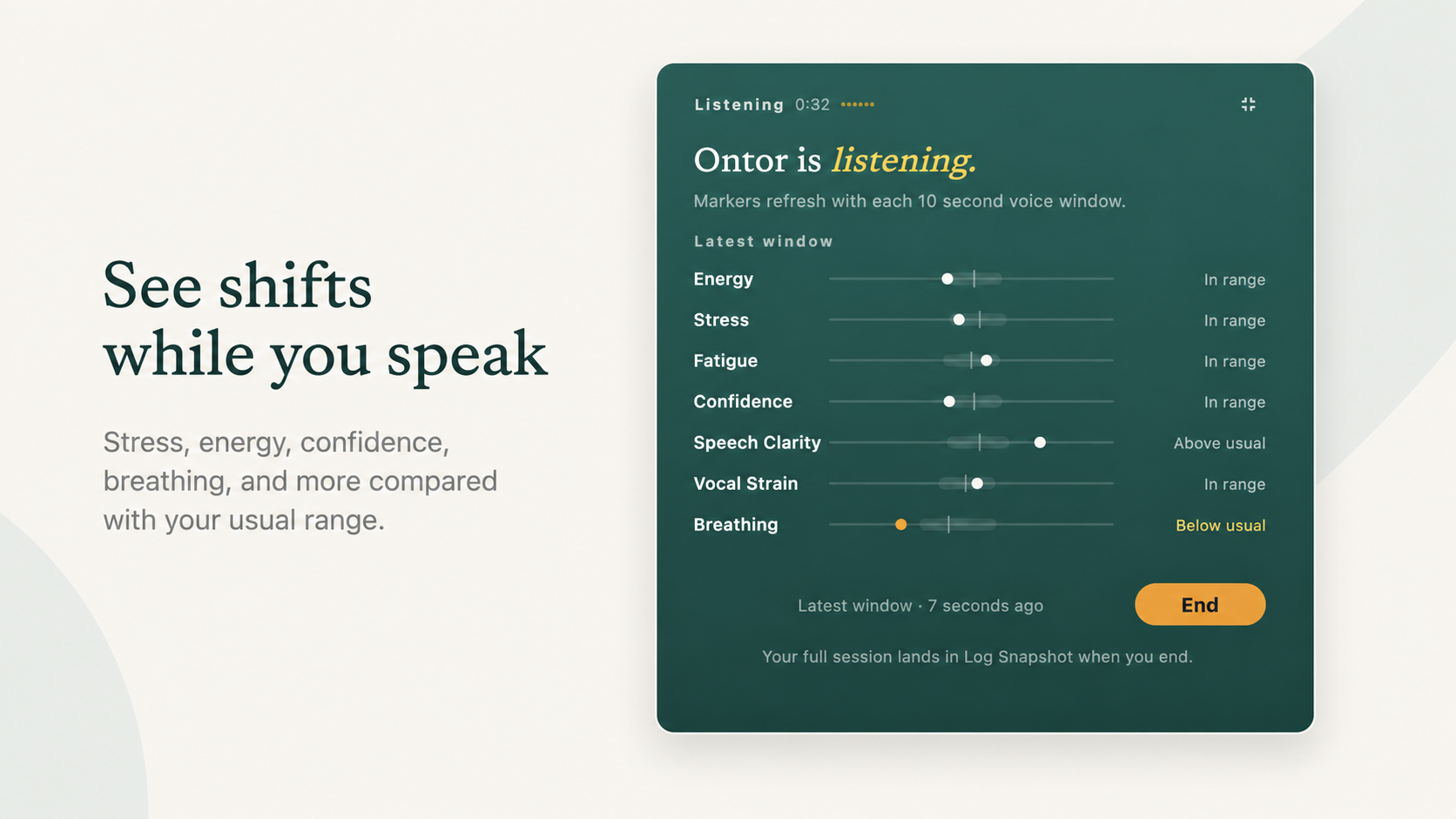
Ontor reads how you sound, not what you said. While someone speaks, it compares voice signals with that person's own usual range. It does not react to every unusual second. It looks for a lasting shift. Signals on the public product page are energy, stress, fatigue, confidence, speech clarity, vocal strain, and breathing. Each one is how the voice sounds versus your own usual range, not a population grade. When a lasting shift shows up, Ontor can suggest a short reset. You can compare before and after.
The live listening view refreshes markers with each 10 second voice window. That is the product's own label, not a clinical sampling claim.
Boundaries, said plainly:
- Ontor does not replace first-party scripts, brand immersion, QA, surveys, or Eppert's validation KPI.
- Ontor does not diagnose triggering, anxiety, or a health condition, and a marker move is not a clinical outcome.
- Ontor does not claim that a marker change proves higher recoveries, fewer complaints, faster ramp, or better retention.
- For teams, leaders see aggregate patterns that can inform workload, coaching, and support. Individual sessions and readings stay with the person. That is not a hire or fire score. Soft secondary path only: Ontor for teams.
In my own Ontor session history (founder exploratory data from my own product use, not your floor's outcome data), the same two windows show up as delivery drift against my personal usual range. A hardship-style conversation can leave stress, confidence, or breathing outside my usual band in the short windows while I still know the words. An ask-for-info stretch can do the same: I am still collecting the facts, and the way I sound has already left the band I usually sit in. That is the how-they-said-it gap and the early validation gap, visible as personal-baseline leave, not as a missed script line. A short optional reset before the next hardship or the next validation ask is a tool step. It is not a claim that one cycle fixes complaints or hang-ups.
Here is live listening from my own Ontor session. Markers refresh with each 10 second voice window and sit against my usual range. Read it as a private check during a triggering hardship or an ask-for-info stretch, not as a QA score:
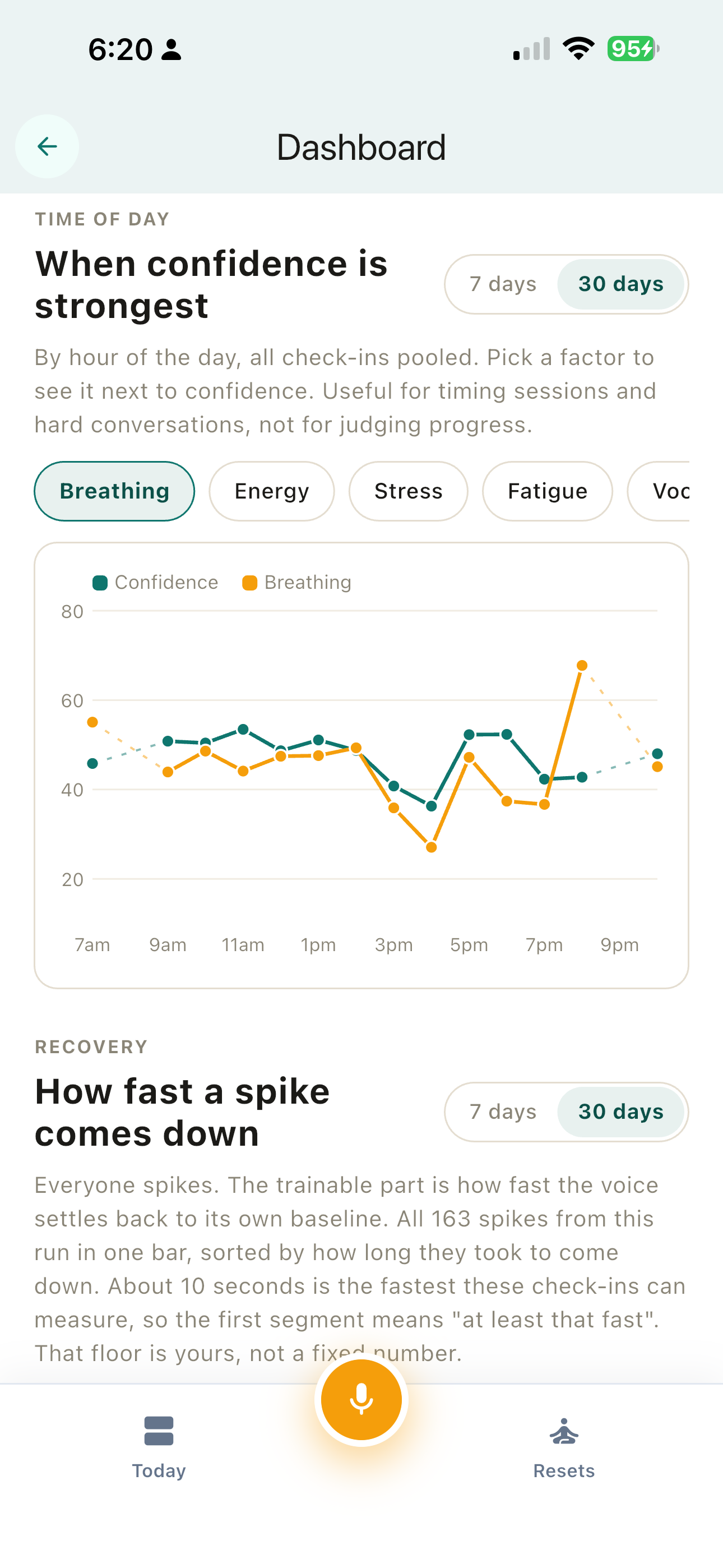
Here is confidence beside breathing by hour from that same session history. The screen is for timing hard conversations, and it says it is not for judging progress. Read the shape as founder exploratory data on how confidence and breathing move across a speaking day, not as proof of first-party complaint rates:
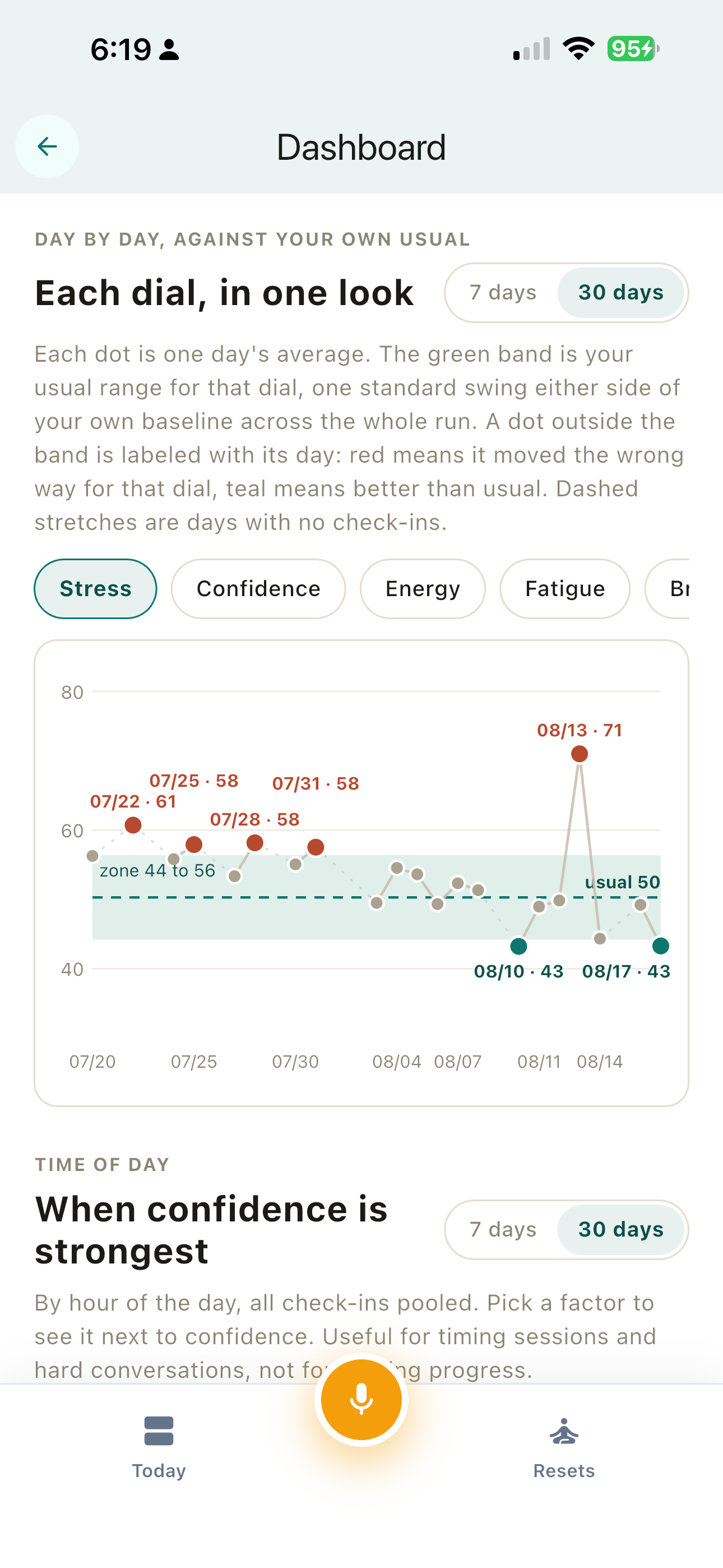
Here is stress day by day against my own usual band. The screen labels a zone of 44 to 56 around a usual of 50, and it marks days that sit outside that band. Useful as a private view of how often voice-state leaves the band across calls. It is not a collector ranking, and it is not proof that a reset caused calmer delivery on the next hardship or validation ask:
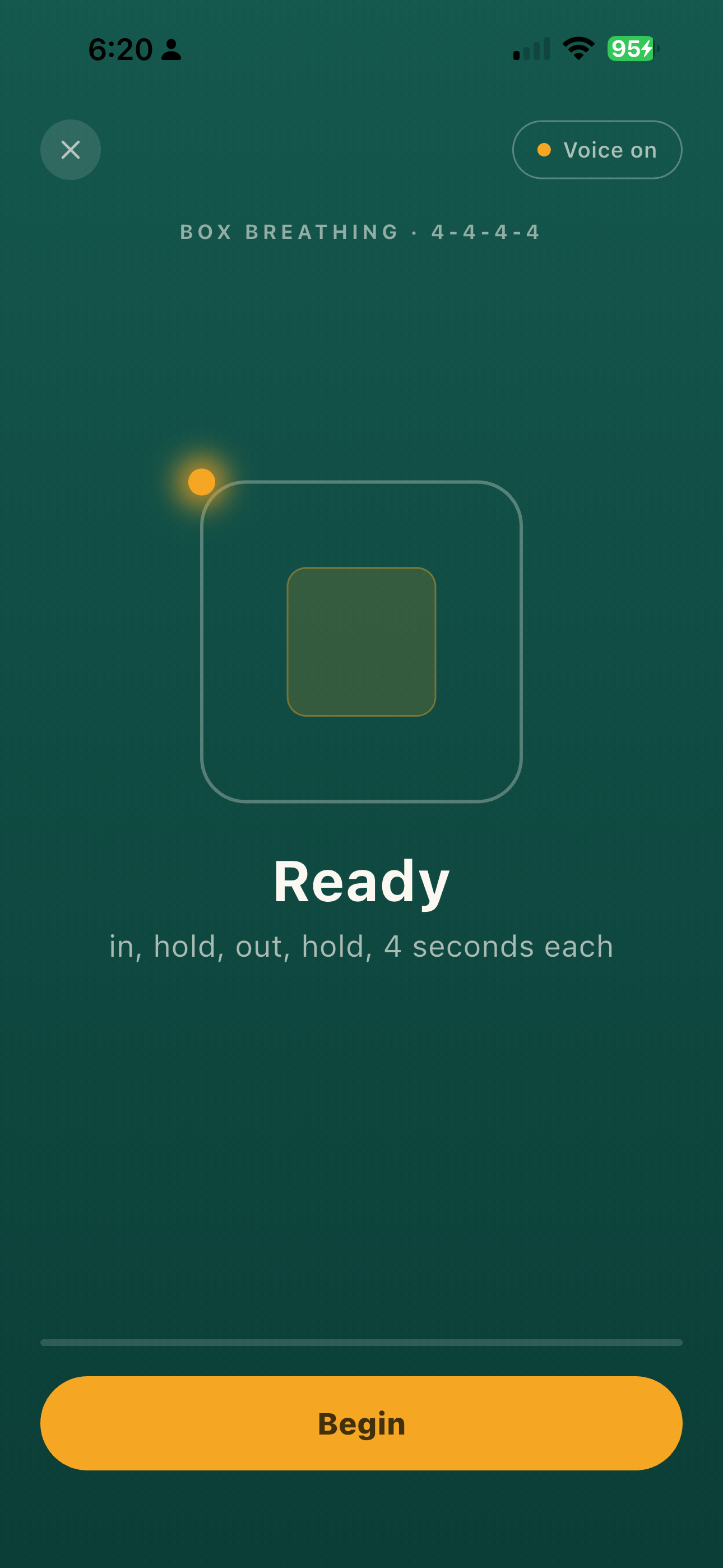
And the short reset the product offers when a lasting shift shows up: box breathing, 4-4-4-4. That is a private pause you can take before the next hardship conversation or the next ask-for-info window. It is not a medical protocol, and it is not a substitute for Conklin's soft-skills training or Eppert's validation KPI:
The claim stays narrow. When recoveries look fine and complaints describe how it sounded, or when hang-ups land in the validation window, a private usual-range cue plus an optional short reset is a loop the collector can run on the next one of those calls. Leaders, if they look at all, look at cohort patterns only.
Download Ontor - 14 days free, no card required
What to try on the next hardship or ask-for-info window
Do not wait for another complaint cycle if you already know dollars and delivery are splitting.
- Install Ontor on the machine you already use for first-party calls.
- On the next hardship conversation, or the next time you ask for information to validate the account, notice whether stress, confidence, energy, clarity, strain, or breathing sit outside your own usual range in the short speech windows. Listen for how it sounds, and for what you are about to leave unsaid, against your personal baseline. Not against a floor average.
- If a lasting shift shows up, take the short suggested reset before you continue the hardship or before the next validation ask. Then place the next call. Do not treat a green recovery report as proof the delivery was fine.
- If you lead training or collection ops, keep personal readings with the person. Use aggregate patterns only if you later want a cohort view of strain on hardship or early-call blocks. Do not turn Ontor into a QA score, a hang-up KPI, or a dialer.
If you run a floor and want a measured team look later, the light secondary path is Ontor for teams. The primary step is still install, on the next call.
Do not promise fewer complaints, fewer hang-ups, or higher recoveries. Measure whether you can tell when delivery left your usual range on a triggering hardship or in the ask-for-info window.
Bottom line
Recoveries can look fine while the complaint is about how they said it. Beth Conklin hears policy and script intact, and still hears delivery: how representatives say it, what they do not say, and hardship conversations that trigger the person who is supposed to stay steady and sound confident. Sherrika Newman separates a good collector (dollars) from a great first-party collector (dollars plus empathy that protects the client relationship). Jason Eppert built a KPI because hang-ups arrive while someone is still asking for validation information, before negotiation. Ontor does not replace that training or that KPI. It shows audible confidence, stress, energy, and breathing against your own usual range in short voice windows, and it can offer a short reset before the next one of those calls.
Try it on the next hardship conversation or the next ask-for-info window. Notice how the delivery sounds versus your personal baseline. Take the short reset if a lasting shift shows up.
Download Ontor - 14 days free, no card required
About the author
Sabber Ahamed is the founder of Ontor and an applied ML scientist (PhD, geophysics and signal processing) who builds on-device voice tools. Ontor compares how you sound with your own usual ranges and can suggest a short reset. Marker changes are not clinical outcomes and they are not revenue proof.
References
- Beth Conklin, Jason Eppert, Sherrika Newman, Christopher Rickman, Mike Gibb. "Training First-Party Collectors: The Key to Winning and Keeping Clients" webinar transcript. AccountsRecovery.net, June 2026. https://www.accountsrecovery.net/wp-content/uploads/2026/06/Training-First-Party-Collectors_-The-Key-to-Winning-and-Keeping-Clients_Transcript.pdf
- Kristine Manjares. "Training First-Party Collectors: The Key to Winning and Keeping Clients" (webinar recap). AccountsRecovery.net, June 5, 2026. https://www.accountsrecovery.net/2026/06/05/training-first-party-collectors-the-key-to-winning-and-keeping-clients/
- Matthew F. Stevens. "Emotional Contagion in Call Centers: Why Calls Differ." https://matthewfstevens.com/emotional-contagion-call-center-agents/ (vendor mechanism only)
- Mary Shores. "3 Steps to Invest in the Collector's Voice." February 2021. https://www.maryshores.com/post/3-steps-to-invest-in-the-collector-s-voice (vendor mechanism only)
- Ontor. "How it works." https://ontor.ai/how-it-works/
- Ontor. "Ontor for teams." https://ontor.ai/for-teams/
- Ontor. "About the founder." https://ontor.ai/about/
- Ontor. "Install Ontor." https://ontor.ai/install/
- Ontor. "We score Empathy & Tone. We still miss when a strong collector drifts off their own baseline." https://ontor.ai/blog/collections-qa-tone-vs-baseline/
- Ontor. "You already live-monitor the floor. You still miss when a collector drifts off their own demeanor." https://ontor.ai/blog/collections-demeanor-drift/
- Ontor. "Tone of voice in the first 10 seconds decides if they stay on the phone." https://ontor.ai/blog/collections-first-10s-tone/
- Ontor. "They teach energy match so you don't go flat under hostility." https://ontor.ai/blog/collections-energy-match-vs-flat-under-hostility/
- Ontor. "You got through Mini-Miranda and RPC. Collectors still freeze." https://ontor.ai/blog/collections-post-rpc-ask-freeze/
- Ontor. "Your remote collectors don't have a hallway." https://ontor.ai/blog/collections-remote-no-hallway-reset/
- Ontor. "Collections leaders can see dials and recovery rates. They still miss readiness after a hostile call." https://ontor.ai/blog/collections-cool-down-between-hostile-calls/
- Ontor. "Collectors sound distracted around breaks." https://ontor.ai/blog/collections-break-window-fatigue/
- Ontor. "They still miss confidence collapse in the first 60 days." https://ontor.ai/blog/collections-early-tenure-confidence/
- Ontor. "You QA Mini-Miranda. You still miss when a collector isn't themselves after a rough open." https://ontor.ai/blog/collections-compliance-hangover-self-reset/
- Ontor. "You trained the words. Consumers still hear the shake." https://ontor.ai/blog/collections-hard-ask-shaky-voice/